Formulate Success | solar
Your proposal is the last thing a homeowner sees before they decide. It's the moment where months of marketing, referrals, and follow-ups either convert—or collapse.Most solar proposals don't lose on price. They lose on clarity. The homeowner can't figure out what they're actually getting, what the numbers mean, or why they should trust you over the next installer.I've sat on both sides of that table. I know what makes a homeowner say yes—and I know what makes them "think about it" and never call back.
You've probably lost deals where you had the better product, the better price, even the better reputation. The homeowner still went with someone else.Here's what's usually happening:Your proposal reads like an engineering document, not a buying decision. The savings math is confusing or buried. The finance options aren't explained in language a homeowner actually understands. There's no visual hierarchy — everything looks equally important, so nothing stands out. And the homeowner can't clearly answer: "Why should I pick this company?"The result: they default to whoever's proposal felt the clearest and most trustworthy. That's not about design. It's about messaging.
Clarity
The homeowner understands exactly what they're buying, what it costs, and what happens next — without needing your rep to explain it.Trust
The proposal demonstrates competence and credibility before your rep says a word. Layout, language, and logic all reinforce: "These people know what they're doing."Momentum
Instead of "let me think about it," homeowners move forward because the proposal removed confusion, not because your rep applied pressure.Margin
When the proposal builds confidence, you stop competing on price. Homeowners choose you because they trust the outcome — not because you're cheapest.

I installed solar on my own home — and before I signed, I reviewed over twenty-five proposals from competing installers. I've seen the good, the bad, and the ugly. I know exactly what made me trust one company over another, and it wasn't price.I also know the tool. I've built several custom proposal templates inside Aurora Solar, and I can tell you firsthand — the editor fights you at every turn. That's why most installers give up and use the defaults. Every proposal ends up looking the same, saying the same things, in the same order. Your homeowner can't tell you apart from the last company that quoted them.That's the gap I close: the pattern recognition of what makes a homeowner say yes — built on reviewing dozens of real proposals — combined with the execution to actually build it inside the tools you already use.
Aurora Close-Ready Proposal System
This isn't a PDF of suggestions. It's implementation — messaging, layout, and structure rebuilt to close.• Proposal audit (1–2 live proposals + your sales flow): I identify exactly where homeowners disengage, get confused, or lose confidence — ranked by revenue impact, not opinion.• Messaging rewrite in homeowner language: Accurate, compliant, and written for someone making a $25K–$60K decision — not an engineer reviewing a spec sheet.• Financial clarity overhaul: Cash vs. finance, savings logic, and payment framing rebuilt so the homeowner understands the math without your rep doing algebra on the spot.• Visual hierarchy and layout rebuild: What the homeowner sees first, second, and last — structured to guide a decision, not dump information.• Rep talk track: What your sales team says when they walk through the proposal, aligned with the messaging so the document and the conversation reinforce each other.Optional: Enablement session + one-page cheat sheet for teams rolling this out across multiple reps.
Aurora Close-Ready Proposal System
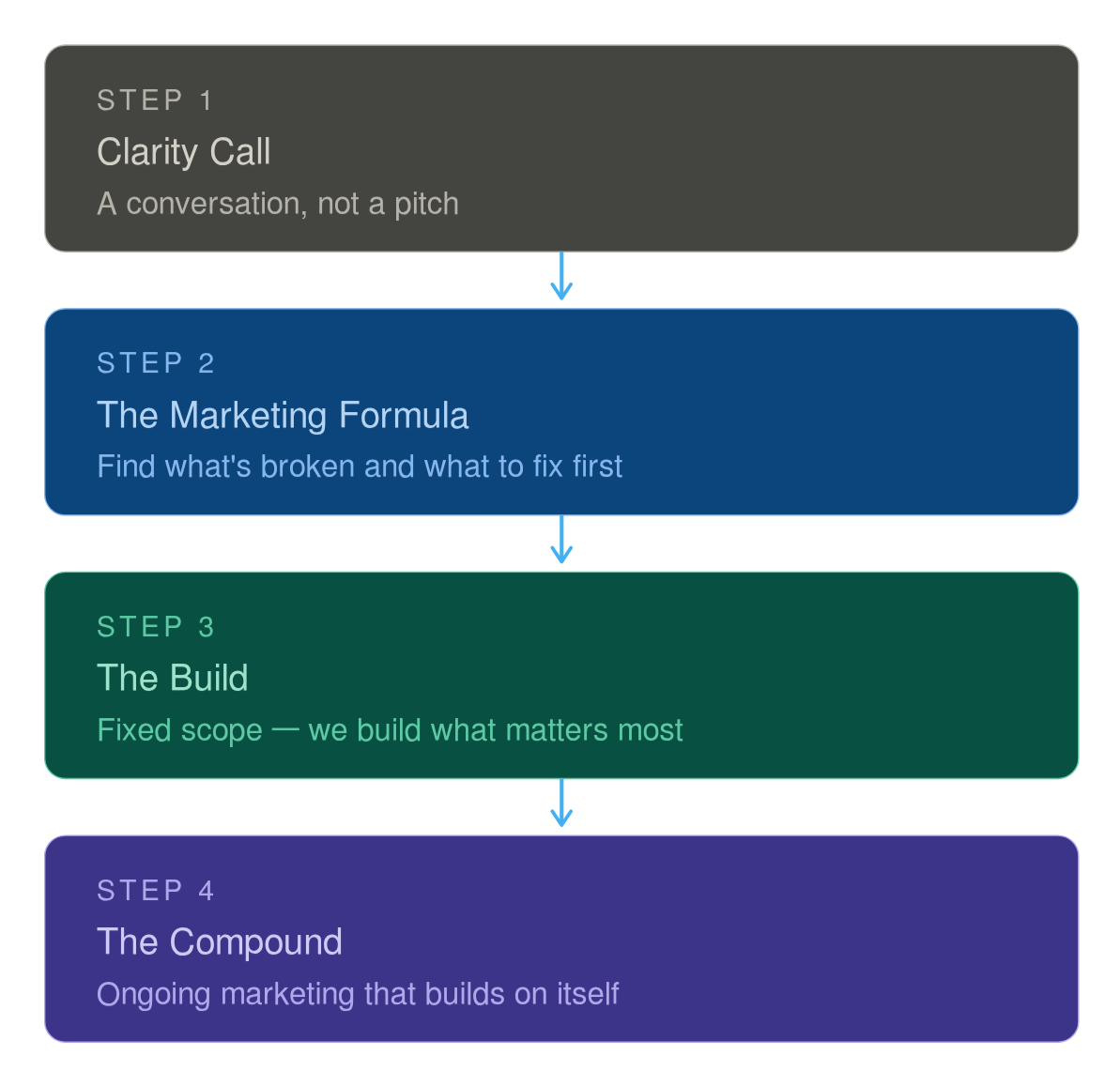
Step 1: You send me 1–2 real proposals and a 15-minute walkthrough of your sales flow.
I need to see what your homeowners actually see — not a sanitized sample. I also want to know what your reps say when they present it, where objections come up, and where deals stall.Step 2: I audit the full buyer experience and rank the close leaks.
You get a scored list of what's costing you deals, marked-up proposal notes showing exactly what to change and where, and a go/no-go recommendation on whether a full rebuild is worth it for your business.Step 3 (if you proceed to the Build): I rebuild the proposal and implement it.
New messaging, new structure, new layout — built inside Aurora so your team can use it immediately. Includes up to two homeowner persona variants and one revision round.Step 4: Your reps start using it. We measure what changes.
No 6-month "strategy engagement." You'll have a working proposal in weeks, not months.

Aurora Close-Ready Proposal System
The fastest way to find out what's costing you closes — without committing to a full rebuild.You get:
• Ranked close-leak list (5–7 issues by revenue impact)
• Marked-up proposal notes (what to change + where)
• Go/no-go recommendation for a full rebuildIf you move forward: The full $2,500 applies as credit toward the Conversion Build if you upgrade within 14 days.
Full proposal rebuild — strategy, messaging, layout, and implementation inside Aurora.You get:
• Everything in the Teardown, plus:
• Complete proposal rebuild + implementation in Aurora
• Up to 2 homeowner persona variants
• Rep talk track aligned to new messaging
• One revision round included
For multi-rep teams that need the proposal, the follow-up sequence, the talk tracks, and an adoption plan that sticks.You get:
• Full proposal rebuild + implementation
• Follow-up messaging sequence
• Rep talk tracks + objection handling
• Enablement rollout plan for multi-rep adoption
• Optimization roadmap
• You're closing 10–30%+ of proposals and believe your close rate should be higher based on your product and reputation.
• You've looked at your proposals and thought "this doesn't represent how good we actually are."
• You're tired of competing on price when you know your installation quality is better.
• You're using Aurora Solar (required for the Conversion Build; Teardown works with any proposal tool).
• You're primarily competing on being the cheapest option in your market.
• You're looking for someone to run your entire marketing — this is proposal-specific, not full-service.
• You don't have a consistent sales process yet (proposals can't fix a broken pipeline).
• You need results in 48 hours — thorough work takes 2–4 weeks depending on scope.
Aurora Close-Ready Proposal System
Do I need to use Aurora Solar?
For the Teardown (Offer A): No. The audit evaluates your proposal as a buyer experience regardless of what software generated it. For the Conversion Build (Offer B): Yes — I rebuild and implement directly inside Aurora. If you use different proposal software, the Teardown still gives you a ranked action plan your team or designer can implement.How do you know this works?
I've been the homeowner. I installed solar on my own home, reviewed multiple competing proposals, and experienced firsthand what builds trust and what kills it. I combine that buyer perspective with marketing strategy and hands-on Aurora experience. (Specific client results shared with permission on request.)What if I just want the Teardown and stop there?
That's completely fine. The Teardown is designed to be valuable on its own — you'll walk away with a prioritized list of what to fix and clear notes on how to fix it. Many installers can take that and run with it internally.How long does this take?
Teardown: delivered within 10 business days. Conversion Build: 2–4 weeks depending on scope and revision cycles. We'll confirm timeline before you commit.What does "up to 2 persona variants" mean?
Different homeowners care about different things. A retiree buying cash has different concerns than a young family financing over 25 years. Persona variants adjust messaging emphasis — not the entire proposal — so the right points land with the right buyer.Is the $2,500 Teardown credit real?
Yes. If you proceed to the Conversion Build within 14 days, the full $2,500 applies to your Build investment. No catch.
Formulate Success is a consultancy built on one premise: the businesses that win high-consideration sales aren't louder — they're clearer.I started my career in a lab coat, earned a patent, and eventually realized that the same discipline that makes good science — hypothesize, test, refine, scale — makes good marketing. I now help technical service companies build sales assets that establish confidence before a rep ever picks up the phone.The solar proposal offer exists because I've been on both sides of that decision.As a buyer, I know what clarity looks like. As a marketer, I know how to build it.As someone who's worked inside Aurora, I know how to implement it without asking you to change your tools.